Walk the bloodline
d’bi.young embodies myth and the power of storytelling in her one-woman tour-de-force blood.claat: one oomaan story

- Born performer d’bi.young continually hones her technique to connect with all audiences – photo: Paula Wilson
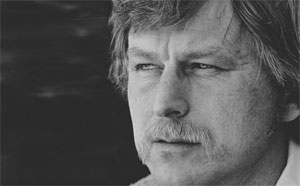
“I have a suggestion,” a photographer grumbled during a media photography session at the Great Canadian Theatre Company space. “Could we move that white sheet please? It’s too white.” The stage manager draped the curtain casually over a clothesline, creating a crumpled mass of white and shadow in the darkened theatre. While camera shutters clicked, trying to capture just the right image of writer and performer d’bi.young, she looked up, considered the change, then grinned at the surly photographer: “Thanks, that’s a great suggestion,” she said in a musical alto. “There’s much more texture now.” At that moment I realized that few people I’ve met are this genuinely unassuming about their art and themselves, willing to listen to the world around them without vanity.
d’bi.young, creator of blood.claat: one oomaan story, is, in many ways, voluminous – yet she doesn’t loom over others when she talks, eating up space; this slim, athletic woman sits poised and prepared, and when she’s ready to respond opens up and pours out personality. Voice, tone, energy, intellect; everything seems to modulate like a tide as she talks, sometimes rising in strength andpower, and sometimes ebbing into ease. She is a marvellous performer even in conversation.
She explains that in Jamaica, where she spent the first 15 years of her life, “storytelling is integrated into the everyday. And I would argue that that reality is so for everybody, because every meeting, every greeting, every glance it’s all performance,” she says with a broad smile. “That sort of theatricality was a part of growing up.”
While d’bi.young’s storytelling and performance poetry does rely on her strength as a performer, it is also steeped in genuine technique. She is the daughter of Anita Stewart, a founding mother of dub poetry, and as she talks about her work she references techniques of orality, of Audre Lorde’s theories, of the connection of rhythm to language, poetry to politics, and everything to myth.
“I love mythology,” she says. “I love the idea of us being able to create our own mythology because for me it’s one big myth. People take things so seriously, but your car, your house, your girl, your man, it’s all myth.”
blood.claat is the story of 15-year-old Mudgu SanKofa, a Jamaican girl going through puberty, faced with all the obstacles and trials of a world that is split between danger, violence, poverty and orthodox religion; where the worst curse is to be called “blood claat.”
“It essentially refers to the cloth that women use during their menstrual cycle,” explains director Weyni Mengesha. “We thought, ‘Something seems terribly wrong about that,’ and we wanted to know more… It’s a story about liberation, about making sacred again those things that maybe have been scorned.”
d’bi.young and Mengesha met touring in a production of Da Kink in My Hair nearly a decade ago and became fast friends. Since then they’ve premiered blood.claat in Toronto, Montreal and Victoria, taken it to the Magnetic North Theatre Festival, won two Dora Awards and are currently being scouted to tour Europe.
In the performance, the audience is drawn into Mudgu’s mind, a world controlled and regulated by the rhythms of reggae music and her own powerful internal mythology. Mudgu becomes the storyteller, with the “room to be able to play with the audience,” says d’bi.young. And she does. Even in a brief media excerpt, original lines were changed and expressions altered or improvised, adding another level of freshness and immediacy. “The audience can’t exist just within the vacuum of itself,” explains d’bi.young. “It’s all about Mudgu’s relationship to the village, to the audience, because in them she sees herself. She wants to win them over.”
As inferred from the title, Mudgu speaks with a tamed yet strong Jamaican accent, with as little anglicizing of the dialect as possible. “You have to believe in the power of storytelling to transcend these supposed obstacles,” says d’bi.young. “Language is only one of the ways in this orchestra of communication.”
Mengesha echoes her sentiment: “There are things that people will not always capture, but there’s an overall experience that washes over the audience and they receive what they need to receive… The idea of watering down the way she has written this language never really occurred to us because we wanted to share this character.”
As appeared in Ottawa XPress – March 4, 2010
http://www.ottawaxpress.ca/stage/stage.aspx?iIDArticle=19428